
WoW Forever Darkspear Islands BG Guide: Map and Tactics
A practical battleground plan for Darkspear Islands: objective calls, defenders, rotations, flag decisions and clearly qualified beta rewards.
A captured point is useful until the last defender wanders off. Then the team may win a fight in the middle and lose the territory that was paying for its lead. This WoW Forever Darkspear Islands BG guide follows those decisions: who stays, who answers an incoming call, and where the flag carrier is actually going. The damage meter won't answer any of them.
Checked on 6 October 2026. Darkspear Islands is the announced new 15v15 battleground. Queue details, reward requirements and some scoring information below come from beta reports, not a final launch rulebook. The tactics are our suggested decision framework; we are not claiming to have measured win rates or tested every route ourselves.
Three calls to practise with your group
| What happens | A useful call | Who stays |
|---|---|---|
| Two enemies approach Cove; two defenders are already there | Cove, two incoming. One nearby player answers if needed | Tower keeps its defender; the rest confirm before moving |
| Our carrier heads to Tower, which is still friendly | Flag to Tower. Escort clears the approach | At least one assigned defender watches the destination |
| Tower is lost while the carrier is travelling | Tower lost. Name another friendly destination | Defenders at the alternative do not all run out to meet the carrier |
These are proposed calls, not recordings of a match. Replace the short point names with your team’s agreed names. Say what changed and which players are moving. Silence from the destination is not confirmation that delivery is still possible.
Choose roles by the job they can do now. A defender needs awareness and ways to delay a capture attempt. An escort needs available healing, control or dispels; the carrier needs a safe destination. A mobile player is useful for rotations only if somebody still covers the point they leave. Gear level or damage alone does not assign these jobs.
Darkspear Islands in one minute
- Secure resource-producing control points and leave defenders behind.
- Call incoming players before the fight reaches the capture area.
- Send only the reinforcements a threatened point needs.
- Give a flag carrier a defended destination and an escort.
- Read the current score before committing to a distant attack.
Blizzard introduces the new map in its What's Next recap. Community descriptions put it between familiar battleground ideas: resource income and a central flag resemble Eye of the Storm, while the capture interactions are compared with Arathi Basin. That combination makes an apparently busy player quite capable of contributing very little if every fight happens away from the useful objectives.
Entry level, queue and what beta does not prove
Icy Veins' PvP overview lists Darkspear entry at level 30, with brackets 30–39, 40–49, 50–59 and 60. The current beta cap is 30; a listed level-60 bracket does not mean ordinary testers can level there now. Battlemasters are at Stormwind Keep and Orgrimmar’s Valley of Honor. Check the bracket shown by your actual queue.
Cross-ruleset matchmaking does not allow a cross-ruleset premade. The reported queue can match Normal, PvP and RP characters together, but friends on different rulesets cannot form one group and enter together. Before arranging an evening, check region, faction, ruleset and level bracket for every character. Once eligible, settle who will defend and who will call rotations before joining.
Repairs, food, drink and usable bag space are worth sorting out before the invitation arrives. The same goes for defensive binds you don't want to hunt for under pressure. An old Classic consumable habit isn't proof that the item is allowed here; any battleground restriction in the current client takes precedence.
For the broader service choices, see WoW Forever PvP Boost.
Map locations and useful callouts
Use the following four-point board to assign defenders and choose a response. It is our tactical schematic, not a terrain map: spacing, paths and travel times are not represented. For terrain, use the Darkspear map image in Icy Veins’ map collection and your client map. Agree the point names from the client before play; the short calls below are planning labels.
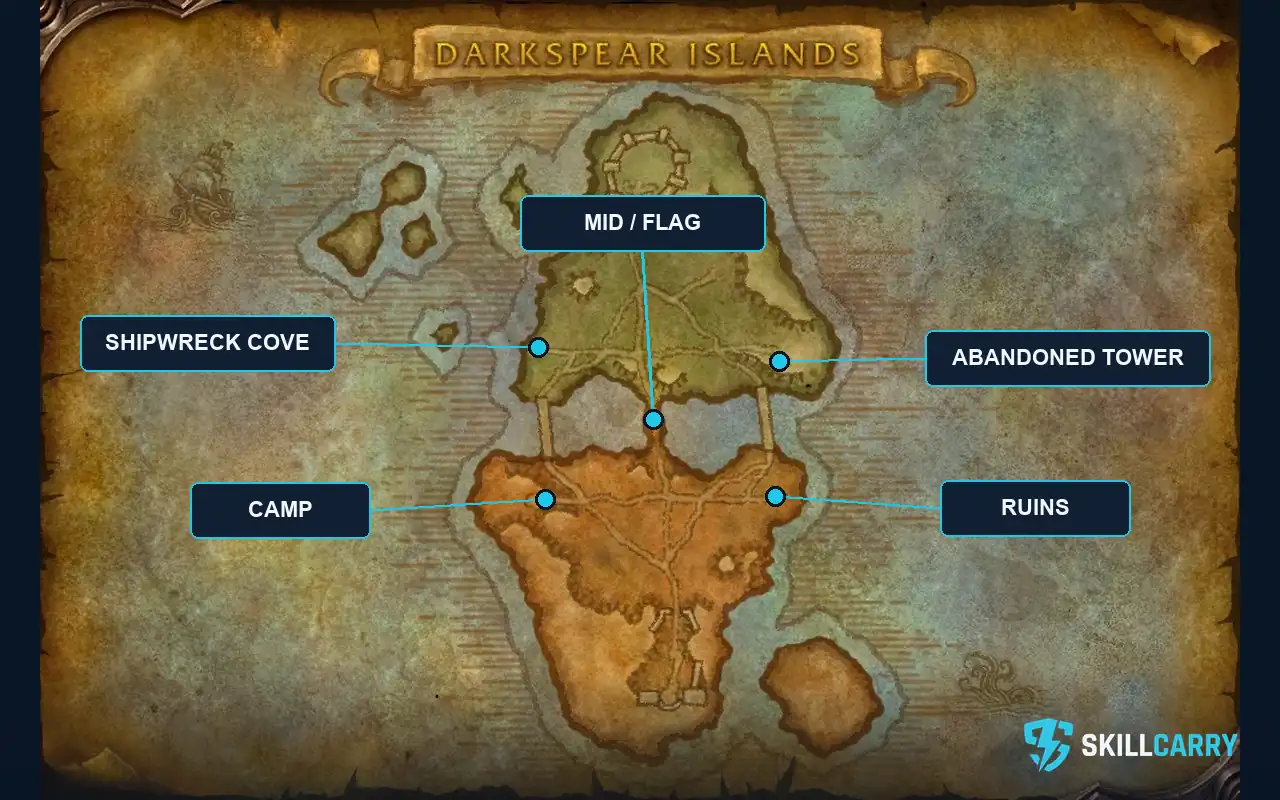
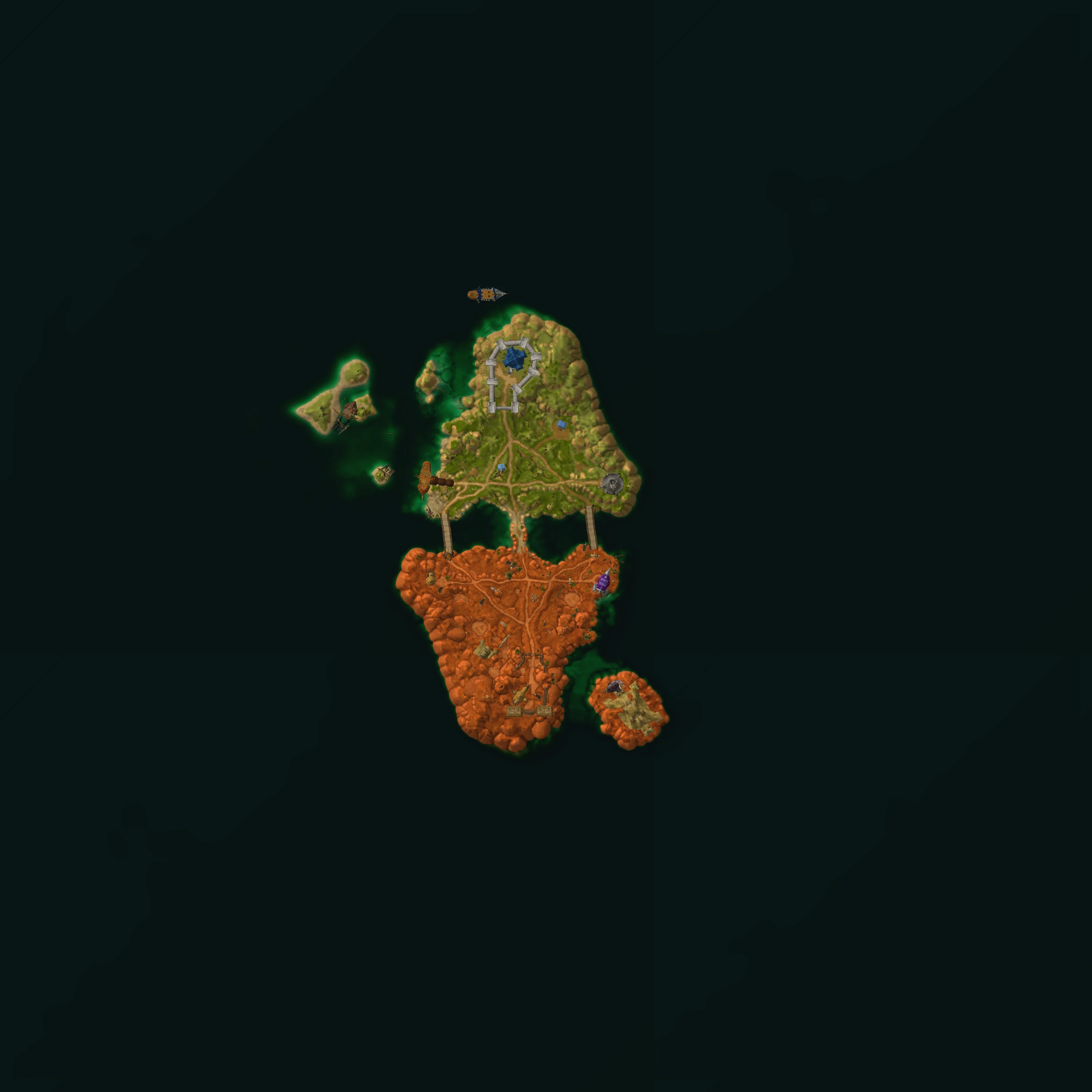
Set current ownership and defender assignments. This is a decision aid, not a live game feed or a winning strategy guarantee.
Agree on names before the gates open. “Left” becomes ambiguous when teammates face different directions. “Tower, three incoming from mid, one healer” gives a location, a threat and a useful detail. Follow it with “two defenders holding” or “capture threatened” as the situation changes.
Scoring: base control first, then a flag plan
The broadly reported beta model awards ongoing resources for controlled points and a scoring bonus for delivering the central flag to a friendly point. The flag should have a destination before the team pays the cost of taking and escorting it.
Read the winning target from the active match counter. We have not established a final launch target from an official rules sheet, so there is no fixed finish-time calculation here. Base ownership and the score trend are enough to tell whether a defensive hold is gaining or losing ground.
The reported beta rules tie the flag bonus to the number of bases held when it is delivered. That makes the timing of a retake matter: a carrier can reach a safe point while another friendly base is falling. The tooltip of Darkspear Islands Flag says delivery requires a controlled point and records a run-speed limiting effect. We have not measured the carrier’s actual pace or checked every movement interaction. Plan an escort before pickup; check the live buff before relying on a movement trick. Tick sizes, capture duration and the exact flag bonus still need client verification.
If your goal is a particular rank, WoW Forever Rank Boost describes that order. Rank Points determine that progress; a flag delivery or a reputation milestone is a different goal.
An opening plan for a mixed team
For a mixed group, an opening that people remember beats a detailed split nobody follows. Give the groups destinations and name the people staying behind after a capture. One caller can then arrange the first reinforcements. The numbers can change when you see the enemy's opening or discover where your healers and mobile players have ended up.
- Secure reachable points. Arrive together enough to survive the first contest. A lone early runner should not expect the whole team to teleport behind them.
- Keep eyes on captured territory. Capturing a point and leaving it completely empty invites a cheap reversal.
- Identify the contested lane. Call enemy numbers and support rather than merely asking everyone to come.
- Choose a limited reinforcement. Send a suitable group while preserving coverage elsewhere.
- Open the flag route when a destination is stable. “Flag to Tower” leaves much less to guess than “follow me.”
With two points held, the enemy can still pull away through stronger income or flag deliveries. That is why the scoreboard belongs in your opening assessment. At that point we'd want a joint attempt to change the scoring, rather than settle into a defence that is visibly losing the race. Another isolated duel leaves the same income problem untouched.
You're the defender: call the approach, then hold
A defender can spend the opening seconds fighting or warning the team. Warning first gives the nearest available help a chance to reach the point while it is still yours. An estimate such as “three from mid” is enough to start that response; you can correct the count once you see the rest. A message sent after the capture explains the loss but leaves much less for a teammate to save.
A position with sight of the capture area and its approaches gives you something to defend. Detection, interrupts, control and survival tools then have a clear job rather than being spent chasing a player into the distance. Pets or damage-over-time effects may help, but their capture interaction needs checking in this build. We'd be wary of betting the whole defence on a remembered rule from another version.
An outnumbered defender is buying time near the objective. Following an attacker out of sight can give a second enemy the opening they wanted, so the capture area needs to remain in view. Leaving creates another decision for the team: is a replacement already coming, or is the point about to have nobody on it? To the players watching another lane, an arranged handover and an empty point look identical until somebody says who's covering it.
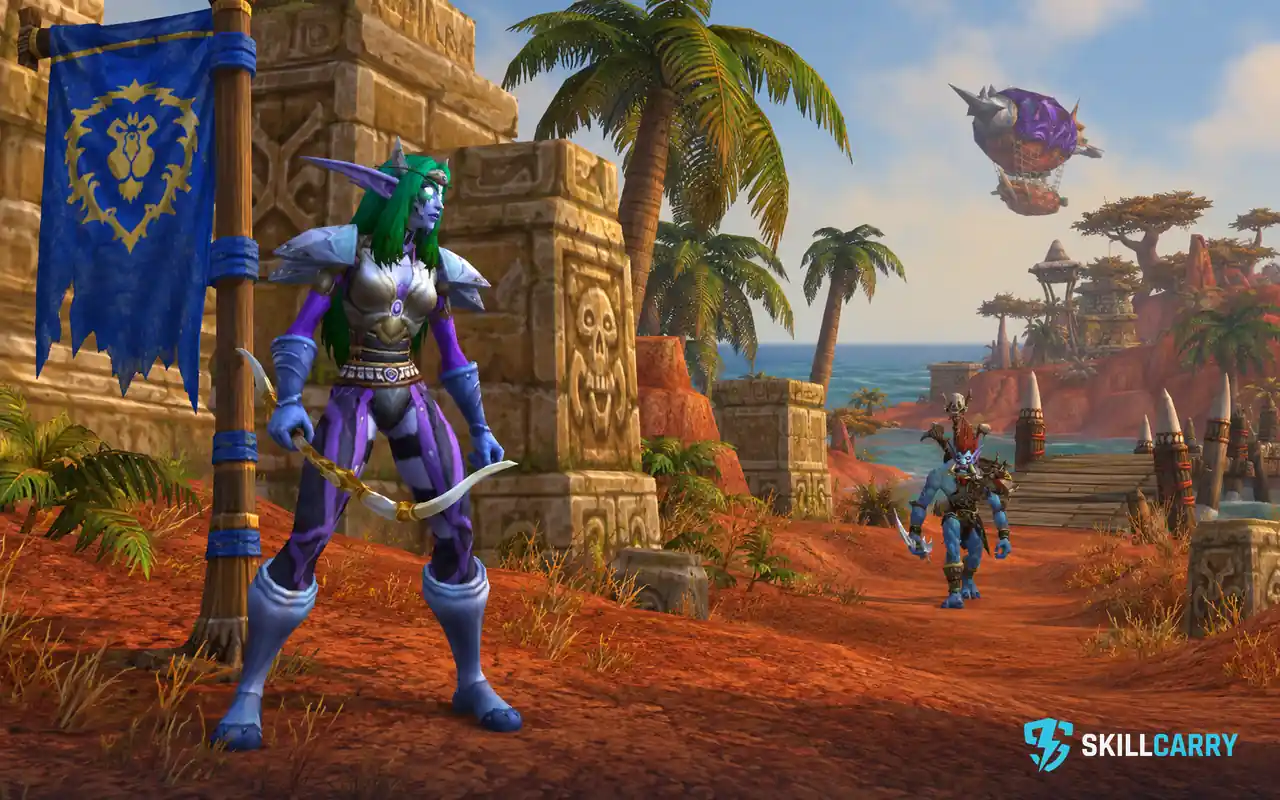
Choosing the reinforcements
The nearest player isn't automatically the best reinforcement. They still have to arrive soon enough to help, and their old position may need somebody on it. A healer may be the useful answer to one fight; slowing an approaching carrier may matter more in another. Sending somebody for the actual job, with cover still at their old position, is a better response than moving everyone who happens to notice the message.
| Situation | Suggested response | Check before moving |
|---|---|---|
| A defended point reports a small attack | Send a limited nearby response | Can the original defenders hold until arrival? |
| Several enemies commit to one point | Reinforce or pressure their exposed position | Will the alternative score before your defence fails? |
| A friendly carrier approaches a point | Keep the destination defended and clear the route | Is that point still owned and usable for delivery? |
| Your team wins a fight in the middle | Convert it into a capture, escort or safe rotation | Which objective benefits from the temporary advantage? |
| Your team is scattered after deaths | Regroup at a relevant objective | Can you arrive together instead of feeding in one by one? |
A short assignment makes the response visible: “Two coming to Cove; Tower stays.” Now the defenders know help is on its way and the rest know they aren't meant to follow. “Everyone Cove” might win that fight, but it also tells the opposition that the other points are about to get cheaper.
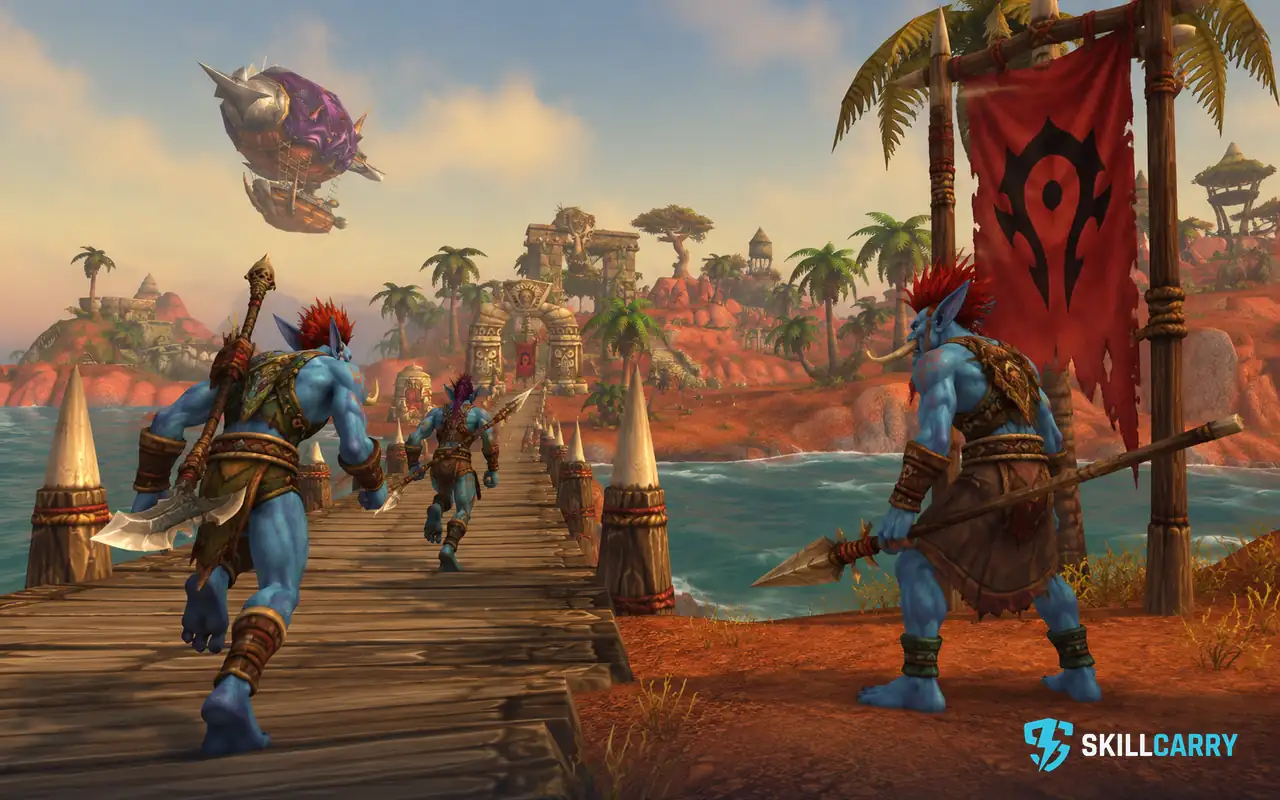
Flag carrier, escort and interception
The flag carrier needs a friendly destination before setting off. Stopping for a duel gives pursuit another chance; the escort's useful cooldowns are the ones that keep the journey moving through a cast, a pursuer or a removable debuff. Spending all of them on damage at the first turn can leave the carrier without an answer at the next one.
The destination's defenders have a job even while the flag is travelling. If they all run out to meet it, an enemy can contest the point behind them and ruin the delivery. A change of ownership needs an early route call, while the carrier still has choices, rather than a correction on arrival.
For an interception, the map needs to suggest a place the carrier must pass. Pressure and control can then meet the carrier together, without drawing the entire team into a long chase. Stopping the flag is only the first gain. The opening afterward might let you retake a point or arrange your own delivery, provided somebody calls that next move.
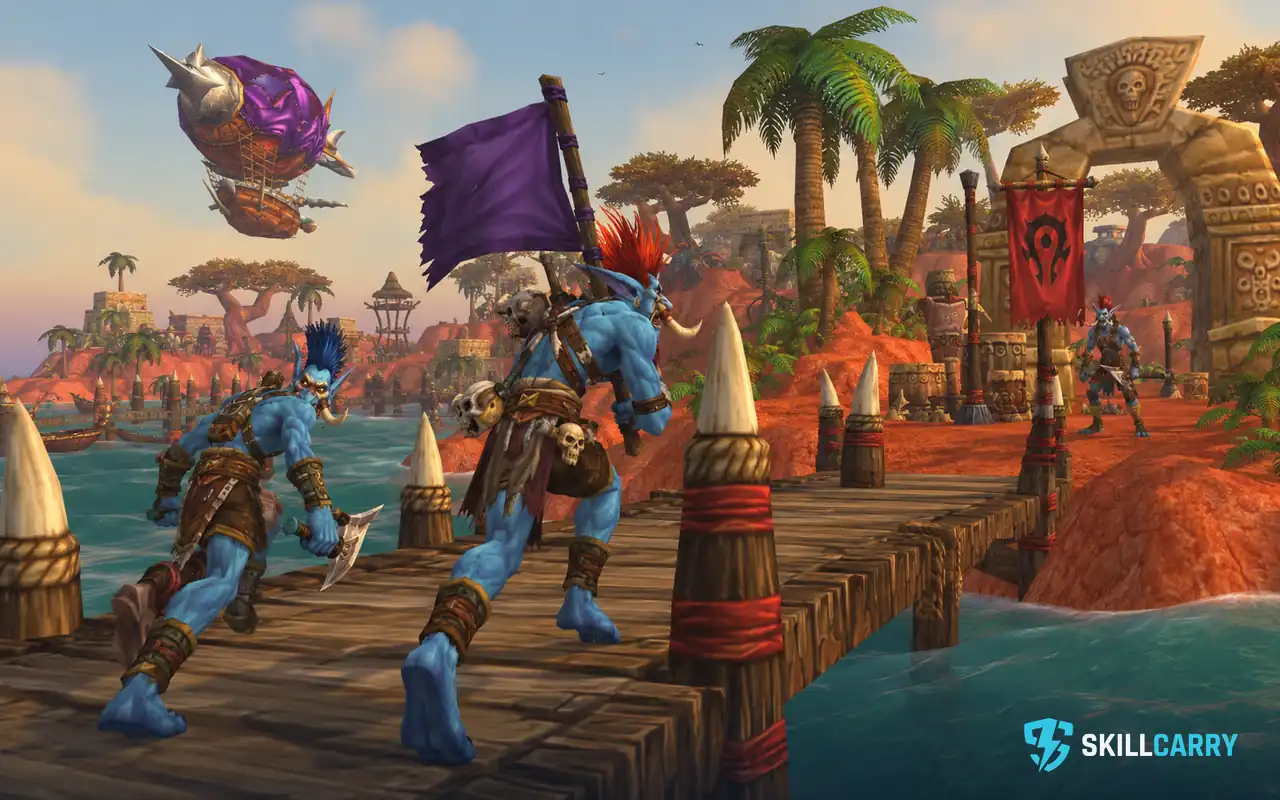
Read the score and choose the next play
When your team is ahead
Being ahead makes a long chase especially expensive: an opponent can take the point you left and gain a place to deliver the flag. We'd favour cover on the held territory and a response to incoming calls. A safe flag escort can improve the finish, but it shouldn't cost the bases generating the lead.
Playing from a deficit
A score deficit can survive several victories in the middle if none of them changes the map. Name the scoring play you want before pulling the team into another fight. For example, taking back a point together changes ownership; clearing a path for a carrier can produce a delivery. Either gives the group a job whose success you can see on the scoreboard.
Watch the gap through the next few score changes. If it keeps growing while your team holds this position, staying there will not produce a comeback. That calls for a scoring attempt now. If it is closing, an unnecessary chase may break the position doing the work. Without current tick values, the trend supports that decision more honestly than an invented countdown.
Honor, Marks and faction reputation rewards
Choose a reward before making this battleground your evening’s project. Alliance players work with Theramore Expeditionary Force; Horde players with Darkspear Raiders. Their reputation unlocks faction purchases. Meanwhile, the Honor purse, Rank Points and Marks record other parts of the same games, so a good reputation session need not have finished your rank goal.
A win awards three battleground Marks and a loss one in the reported system. Those Marks may be needed for the item you want, which is a reason to reserve them before a turn-in. Open the exact item at the vendor and read its level, standing and currency requirements. A database preview is useful for planning, but it cannot complete that purchase for you.
Which reputation milestone is worth your time?
| Standing | Slots to check | Before committing sessions |
|---|---|---|
| Friendly | Trinkets | Compare the effect of Enriched Seal / Darkspear Voodoo Seal with Volunteer’s Lucky Seal / Relentless Raider’s Seal for your role. |
| Honored | Cloak, rings, necklace | Compare the exact level variant with the item you already wear; the faction name alone does not identify its stats. |
| Revered | Weapons and off-hand | Check weapon proficiency, damage or caster stats and the level requirement. A listed weapon is not automatically best for your spec. |
| Exalted | Gloves, shoulders and tabard | Choose the correct armor type and role. Do not farm Exalted only to discover that your next purchase is already available at Honored. |
Use this as a shopping shortlist, then inspect the exact item at the vendor. Some names have several level variants. The table is not a current vendor price list. If you need Marks for a purchase, reserve them before exchanging spare Marks for experience or reputation. Rank-gated Honor upgrades are a separate reward path.
For a currency goal, WoW Forever Honor Farming describes the service scope. Earned Honor, rank progress and a particular reputation reward should not be assumed to be one purchase.
If your goal is a title or an upgrade gate, read the rank farming guide for the weekly plan. This page stays focused on playing Darkspear Islands.
After the match: which call would you change?
- Was anyone still guarding Cove when it fell?
- Was the first incoming call early enough for help to arrive?
- Did reinforcements fix one point while abandoning another?
- Did each flag attempt have a defended destination?
- What one assignment should change next match?
Keep the review short and specific. “We lost Cove while three players chased mid” suggests a fix. “Bad team” does not. Over several games, this gives a more useful improvement plan than sorting the damage meter.
Darkspear Islands FAQ
How many players are in Darkspear Islands?
It's a 15v15 battleground: fifteen on your faction's team, with thirty players if both sides are full.
Which winning score should I follow?
Use the target displayed in the current match. Beta previews can change, and an unverified number should not decide whether your team holds or makes a final push.
Should everyone rush the central flag?
No. A flag attempt needs controlled territory and a viable destination. Assign capture and defence jobs first, then commit an appropriate carrier group.
What is the most useful call for a defender?
Try a call such as “Tower, three from mid; two of us defending.” Update the call if ownership or the threat changes.
Does Darkspear reputation automatically give rank 14?
No. Reputation unlocks its faction rewards; Rank Points advance the separate rank track with its own ceiling. A session can help several goals without making them interchangeable.